Online PD Measurement: Your Pupillary Distance From a Photo
One front-facing photo, no card, no app, no ruler to print. A 478-point face mesh finds your irises and uses an assumed 11.7 mm iris diameter to estimate PD, an image-side split and cheek width. The near value is a convention, not an individual near measurement. Free, processed in your browser.
For a reliable reading: face the camera squarely, look into the lens (not the screen), eyes open, even light.
Upload a photo
Drag and drop or choose a file
JPG, PNG or HEIC, up to 30MB
Your photo never leaves your device
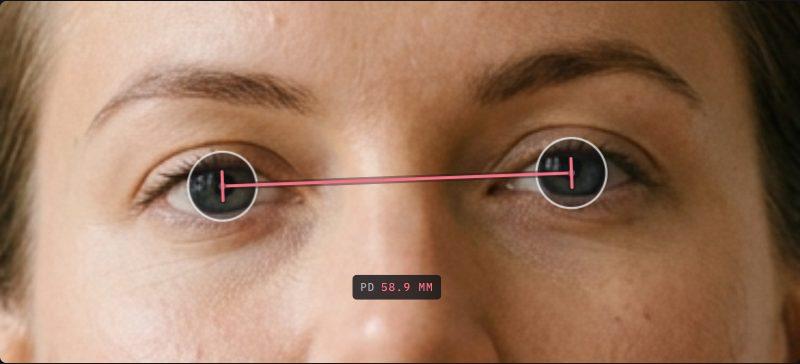 Example
What Is Pupillary Distance (PD)?
Pupillary distance is the distance between pupil centres in millimetres. Optical fitting also depends on the prescription, lens design and how frames sit. Ask an optician to confirm the appropriate distance, near and monocular values before ordering prescription lenses.
Distance PD is measured while looking far away. Monocular values measure each eye relative to the bridge; near PD depends on the viewing distance. This tool estimates a distance figure, an image-side split and a near convention. Image sides must not be copied into right-eye/left-eye order fields.
How an Online PD Measurement From a Photo Works
A photo has no known physical scale. This tool assumes an iris diameter of 11.7 mm, which varies between people. The reference method divides the detected iris span by 1.054, converts the pupil span and adds 1.5 mm. Those are modelling assumptions, not a calibration validated by mytype fyi. Head pose, perspective and detection error remain.
Google’s reported 4.3% mean error concerns camera-to-person depth estimation, not clinical PD accuracy. This site has not established a PD error bound or tested suitability for prescription ordering. The displayed sensitivity only shows how an assumed iris-size change affects the estimate; other errors can be larger. References: Google Research. College of Optometrists.
Photo Tool, Printable PD Ruler, PD App or Optician?
Every PD measurement method answers the same question with a different ruler. The table shows what each one needs and where it is the right choice.
| Method | You need | Reads | Best for |
|---|---|---|---|
| Photo tool on this page | One selfie from any phone or laptop camera. | Approximate iris-scaled PD, image-side split and a fixed near convention; no validated error bound. | Exploration and comparison before a professional fitting. |
| Printable PD ruler | A printer at 100% and a mirror, or a friend to read it. | A manual home reading after checking printer scale. Repeat with fresh alignment. | A home comparison, not proof of prescription accuracy. |
| PD measurement apps and retailers' digital PD rulers | A phone, and usually a bank card held flat against the brow as the scale. | Binocular PD, sometimes dual. Accuracy rests on the card sitting flat and square. | Ordering from that retailer. |
| Optician with a pupillometer | An appointment. | Individual distance, near and monocular measurements for the intended lenses. | Strong prescriptions, progressives, children. |
Agreement between two home readings shows repeatability, not accuracy. If readings differ, check scale and alignment and have an optician confirm the measurement. Do not resolve a prescription-fitting disagreement by averaging incompatible readings.
Average Pupillary Distance
| Group | Typical PD | Note |
|---|---|---|
| Adults (all) | ≈63 mm | A broad adult reference span is about 50–75 mm; individuals can fall outside it. |
| Adult men | Study-dependent | Group averages overlap and are not individual fitting values. |
| Adult women | Study-dependent | Group averages overlap and are not individual fitting values. |
| Children | Varies with age | Obtain individual professional measurements for growing children. |
Dodgson (2004) reviewed population variation and reported a mean near 63 mm, with most adults in a broad 50–75 mm span and some outside it. These are descriptive population references, not a diagnostic range or fitting tolerance. Read the original paper.
How to Read PD on Your Prescription
PD 63
A single binocular distance PD: pupil centre to pupil centre, looking far away.
PD 31.5 / 31.5 (or R 32 / L 31)
Dual or monocular PD: the distance from the bridge of the nose to each pupil. The two rarely match exactly - faces are not symmetric.
PD 63 / 60
Distance PD then near PD. A fixed 3 mm subtraction is a rough convention; your near PD depends on viewing distance and individual geometry.
Getting an Accurate Reading
Face the camera squarely
Head turn foreshortens one iris and one half of the PD. The tool withholds a number above 10° of turn, or with the chin more than 25° down or 18° up, rather than guess.
Look straight into the lens
Distance PD is measured with the eyes fixed far away. Looking at the screen instead of the lens converges the eyes and shortens the reading by a millimetre or two.
Fill the frame, even light
The iris is the ruler, so it needs to be sharp: face at least a third of the frame height, eyes open, no strong shadows across them. Glasses are fine; heavy reflections are not.
Ordering strong lenses? Confirm it
Prescription power and lens design affect how measurement errors matter. Have an optician confirm the measurement before prescription use; this photo tool has no validated prescription-specific tolerance.
Frequently Asked Questions
What is pupillary distance?
Pupillary distance (PD) is the distance between the centres of your pupils in millimetres. Lens makers use it to put the optical centre of each lens directly in front of each eye; if the centres are off, the lenses act as weak prisms and can cause eye strain or blur. It appears on a prescription as one number (binocular, e.g. 63) or two (monocular, e.g. 31.5/31.5), sometimes with a second, smaller near value for reading.
How accurate is an online PD measurement from a photo?
The tool assumes an 11.7 mm iris diameter. A 1.054 ring divisor and +1.5 mm distance offset reproduce the reference method; this site has not independently calibrated them. The near value subtracts 3 mm by convention. Neither the displayed sensitivity nor Google’s depth-estimation study establishes the accuracy of this PD estimate. Confirm with an optician before prescription use.
What is a normal pupillary distance?
Population averages vary with the study. Dodgson (2004) found a mean near 63 mm and a broad adult span of about 50–75 mm, with outliers. A population reference is not a target and cannot validate a photo result. Children need individual professional fitting.
What is the difference between distance PD and near PD?
Distance PD is measured looking far away. Near PD is measured at the intended reading distance. This tool’s near value is a fixed 3 mm subtraction, not a separate observation of your near gaze. An optician can measure it for your lenses.
Why does my prescription show two PD numbers?
Two numbers around 30-35 are monocular PDs, also written as dual PD: the distance from the bridge of your nose to each pupil, right eye first. They are more precise than one binocular number because most faces are not symmetric, and progressive lenses in particular are cut to them. Add the two together to get the binocular PD. Two numbers like 63/60 are distance and near PD instead.
What happens if my PD is wrong by a few millimetres?
A PD error can change optical alignment; the effect depends on lens power and design. There is no universal “safe” error established for this tool. Have an optician confirm the required values rather than using a photo estimate to decide whether a prescription will tolerate an error.
Can I measure my PD at home with a ruler?
Yes. Stand about 20 cm from a mirror, hold a millimetre ruler flat against your brow, close your right eye and line the zero up with the centre of your left pupil, then close your left eye and read the mark at the centre of your right pupil without moving the ruler. Repeat three times and average. Our printable PD ruler has the scale and a bank-card outline to confirm your printer kept it at true size.
Do I need a PD measurement app?
No app is needed for this on-device estimate. Other tools may use a card, a depth sensor or an optical instrument; they are different measurement methods. If readings disagree, check scale and alignment and ask an optician. Repeated agreement does not establish clinical accuracy.
Which PD do I enter when ordering glasses online?
Use the values and eye order confirmed by your dispensing professional. A form may request one distance PD, two anatomical-eye monocular PDs or a near value. This tool labels photo image sides, which may be mirrored, and uses a fixed near convention; do not substitute these unconfirmed values for a professional fitting.
Can I use my phone screen as a digital PD ruler?
Only after calibrating it. Screens differ in pixel density, so an on-screen millimetre scale is true size only once you have matched it against a bank card, and a phone held flat to your brow is awkward to read in a mirror. The photo measurement above avoids the problem by using your iris as the scale, and the printable PD ruler is true size on paper at 100%. If you do use a screen ruler, check it against a card first.
Does pupillary distance change with age?
PD varies with growth and the measurement conditions, including near versus distance gaze. This photo estimator cannot determine whether a small change is biological or measurement error. For a changed prescription or a child’s frames, obtain a fresh professional fitting.
Is my photo uploaded to measure my PD?
The iris detection and millimetre estimate run on your device. Visiting the ruler or the optional report keeps one photo locally for up to two hours so you can return; you can clear temporary photos on the data page. This tool does not upload the photo. Remote AI requires a separate explicit consent.